
Symbiosis Coalition and CrossBoundary Group Release the Carbon Offtake Guide
The guide provides practical approaches for managing delivery risk in long-term carbon offtake agreements.
Symbiosis Coalition and CrossBoundary Group today released “The Carbon Offtake Guide: Managing Delivery Risk in Long-term Carbon Offtake Agreements for Nature-based Carbon Removals.” The guide shares clear, practical approaches to allocating and managing delivery risk in long-term offtake agreements for nature-based carbon removals, building a shared understanding among buyers, investors and developers that can increase the speed of deal making and support new buyers coming into the market.
This guide is the result of months of work in collaboration with buyers, developers and investors to understand what is and isn't working in long-term carbon offtake agreements, focusing on the core challenge of managing delivery risk. Last year at New York Climate Week, Symbiosis Coalition and CrossBoundary brought together 20 developers, buyers, and investors for a candid conversation about their experience with risk allocation in offtake agreements in the carbon market. The conversation, alongside wide-ranging interviews before and after the workshop, shaped the Carbon Offtake Guide that we are releasing today. The goal of the guide is to make these insights widely accessible to the market, and create a shared understanding of the options and trade-offs to allow more buyers to buy, more developers to structure agreements that are financeable, and more deals to close.
Key Insights:
Nature-based carbon removal projects are essential for climate action but require investor confidence in future cash flows to scale. Long-term offtake agreements, modeled after power purchase agreements (PPAs) in renewable energy, can provide price and volume certainty, reducing demand risk and unlocking project finance.
Delivery risk, the risk that contracted carbon credits are not delivered as promised, remains a central concern. This risk evolves throughout a project’s lifecycle, from development (where implementation and permitting risks dominate) to operations (where natural hazards, community relations, and ongoing performance, including carbon methodology risk, become more prominent).
Buyers face real costs from underdelivery, including transaction and opportunity costs, replacement costs for credits, and reputational and/or regulatory risks. They seek to reduce the likelihood of underdelivery through due diligence, incentive alignment, milestone-based contracts, and ongoing monitoring, and to mitigate losses through financial compensation and robust remedies.
Delivery risk can also be managed through a combination of contractual terms (e.g. underdelivery penalties, etc.) and security instruments (e.g., letters of credit, escrow accounts, guarantees, insurance, etc.). Each tool has trade-offs in terms of cost, accessibility, and effectiveness. Many tools add cost or are challenging for developers to access.
Security instruments, especially those requiring immobilized cash collateral, can significantly increase developers’ financing needs and impact carbon credit prices. Developers are advised to plan early, build strong banking relationships, and, where preferred instruments (e.g., letters of credit or guarantees) are not feasible, consider alternatives such as escrow or insurance.
Carbon delivery risk insurance is emerging as another risk allocation instrument that can provide more efficient and lower cost delivery risk protection, which may be suitable for some developers or buyers’ needs.
Developers should calculate the full cost of providing seller security and include these costs in the price of carbon credits. Transparent communication of these costs to buyers is essential for fair and efficient negotiations.
As the market matures, risk management practices are expected to become more balanced and efficient, ultimately reducing the cost of capital and enabling broader participation.
Long-term offtake agreements are critical to financing nature-based carbon removal projects. By committing to purchase credits at future issuance, buyers provide developers and investors with price and volume certainty that can reduce demand risk and unlock project finance. Just as power purchase agreements gave the renewable energy sector the financial predictability it needed to scale, long-term carbon offtakes can do the same for nature-based solutions. But the analogy only goes so far. Nature-based carbon projects have different constraints and challenges in a more nascent market compared to renewables infrastructure.
The guide is honest about where tools drawn from other sectors fall short today but argues that despite these limitations, the point is not to invent new tools. The goal is to create enough shared understanding of the options and trade-offs to evolve those tools and for the market to mature and scale. As more offtake agreements are signed and standardized, enabled in part by the mechanisms discussed in the guide, the market will be better positioned to scale investment, bring in new buyers, and deliver impact at the pace required.
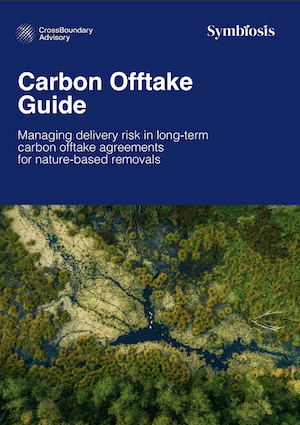
The Carbon Offtake Guide is now available here. We welcome feedback and ideas for what other resources you'd like to see in the future.
Symbiosis Coalition is a buyers coalition that aims to grow the market for nature-based carbon removal by offering companies a straightforward and impactful way to add high-integrity, nature-based carbon removal to their climate action portfolio. Symbiosis members have the opportunity to learn alongside other buyers, leverage our expertise in project evaluation and deal structures, and have an even greater positive climate and nature impact than acting alone. To learn more about joining the Coalition, reach out to buyers@symbiosiscoalition.org
CrossBoundary is an investment and advisory firm focused on unlocking capital in underserved markets. To get in touch with the Natural Capital team, contact naturalcapital@crossboundary.com.