
Symbiosis is focused on catalyzing and scaling nature-based carbon removal projects that meet the highest quality bar for planet and people.
We aim to integrate the most recent science and data on the climate impact of restoration while equitably involving and compensating Indigenous Peoples and local communities.
SYMBIOSIS QUALITY PILLARS guide the development of project-specific criteria. These pillars are meant to reflect the most current and rigorous science, data, and best practice. They build on existing standards and, at minimum, align with the Integrity Council for the Voluntary Carbon Market (IC-VCM) Core Carbon Principles (CCPs).
Quality Pillars

-
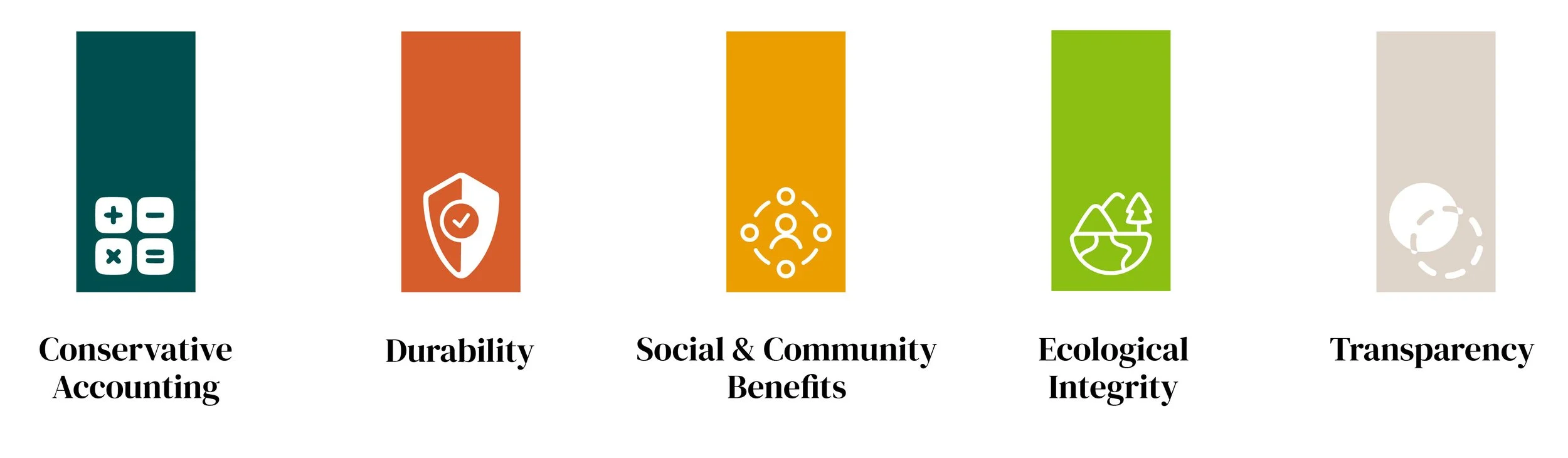
Use conservative carbon accounting, baselining, additionality, and leakage approaches based on the latest science and data to provide high certainty of real climate mitigation.

-
Create the conditions for lasting impact while monitoring, accounting for, and supporting mechanisms to fully compensate for reversals.

-
Engage local communities equitably and fairly, prioritize projects that integrate local leadership throughout the project life cycle, and confer net-positive financial and social benefits that are distributed fairly.

-
Provide details on project activities that enable independent evaluation of successes (e.g., over-performance) and failures (e.g., over-crediting).

-
Prioritize approaches with high biodiversity and ecological value while ensuring climate benefit, and at minimum, do no net harm to ecosystems.

Quality Criteria

SYMBIOSIS QUALITY CRITERIA attempt to strike the balance between being specific enough to be actionable but flexible enough to allow for innovation and consideration of project specific contexts. These criteria reflect the latest and greatest science, data, and best practice and build on existing standards and guidance such as UN’s 10 Principles for Ecosystem Restoration to Guide the United Nations Decade 2021-2030, High Quality Blue Carbon Principles and Guidance, and Integrity Council for the Voluntary Carbon Market’s Core Carbon Principles.
The Quality Criteria apply across all ecosystems, reflecting that the core principles of quality are common to all nature-based carbon removal project types. Where science or operational realities differ meaningfully, our Quality Criteria call out ecosystem-specific guidance.
Each Criterion ties back to one or more of the five Symbiosis Quality Pillars, with many criteria supporting multiple pillars at once. Rather than functioning as standalone checkboxes, the criteria illustrate how these elements work together to shape overall project quality.
Symbiosis will review and, where necessary, update its quality criteria on an annual basis (at minimum) in partnership with its Technical Advisory Board and other independent, third-party experts to reflect lessons learned, emerging science, standard changes, and best practice.
We have designed the Quality Criteria to be high-level, durable, and apply across geographies, reserving changes to the criteria themselves for major advances in science or standards. More granular and evolving technical guidance can be found in our supporting RFP documentation. This allows us to ground our diligence in the latest data, evidence, and methods for the specific project context (including geography) without repeatedly redefining the criteria developers rely on.
Symbiosis also acknowledges that project developers may have limited in-house expertise or resources to conduct the analyses and efforts it requests. Developers can look to its “Resources for Early Stage Projects” to identify potential support.

-
Projects use a publicly consulted methodology from standards approved by the ICVCM. The selected methodology is appropriate for the ecological and socioeconomic conditions of the project location, and for the proposed project interventions or activities (e.g., agroforestry, assisted natural regeneration, mangrove restoration, or a mixture of activities).
All projects must use a dynamic performance benchmark that tracks carbon stock change in statistically matched controls throughout the project’s lifetime. Ex-ante baseline assessments and other forms of ex-ante additionality assessments may also be necessary for determining likely project impact prior to commencement. Projects provide acceptable justification of donor pool area and control plots selection, using an appropriate stocking index for the region, including a well documented justification for the choice.
Projects will use (or collect) relevant data and provide information in publicly available materials to document the baseline and any assumptions made in its development. If applicable, projects will also demonstrate that the baseline accounts for avoided emissions.
For reforestation and agroforestry, projects use a quantification methodology that generally aligns with the principles of the ABACUS label.
For mangrove restoration, projects use a quantification methodology that aligns with the High-Quality Blue Carbon Guidance of employing the best information, interventions, and carbon accounting practices and follows Section 3.1 of the High-Quality Blue Carbon Practitioners Guide 2024, Version 1.0. In highly degraded mangroves, we may consider some projects without dynamic baselines on a case-by-case basis.
Projects appropriately deduct the contribution of allochthonous carbon. Projects should collect field sediment samples to a minimum depth determined by a time marker (such as feldspar horizon marker), measure C content in a laboratory, and baseline development should follow best practice for projection and monitoring ensuring conservatism.
Projects should measure porewater salinity over the project’s lifetime to model CH4 and N2O emissions.
-
Use robust and defensible field inventory and carbon density measurements to project GHG removals, selecting peer-reviewed and geographically or geomorphically appropriate allometric equations developed for the same context (natural or planted forests), species or genus, and location, when available.
In reforestation and agroforestry projects, estimates of aboveground biomass and soil organic carbon (SOC) should always be based on directly measured in-situ data.
In mangrove projects, remote-sensing techniques can be used to monitor biomass only (not SOC) in project plots, but models must be locally or regionally calibrated with direct field measurements. SOC accumulation and/or loss rates should be directly measured on an ex-post basis and based on a scientifically robust understanding of carbon stocks and sediment dynamics across the entire project area on an ex-ante basis. Calculations should account for the additional SOC accumulation and/or loss attributable to project activities, relative to the baseline scenario - which may, for example, include existing but degraded mangrove cover.
Estimates of carbon stocks and fluxes from biomass in control plots should be derived from appropriate remote sensing products (i.e., locally calibrated stocking index with high correlations with AGB).All data, models, and uncertainty estimates should be transparently reported and made publicly available.

-
Eliminate the effect of leakage by targeting unproductive lands or maintaining production in the project area or at a suitable alternative location. If complete leakage risk mitigation is not possible, a leakage deduction must be applied
-
Projects are explicitly designed to quantify and mitigate reversal risk due to fire, storms, and other relevant disturbance agents. Projects are annually and comprehensively monitored to increase transparency (e.g., report seedling mortality), are designed to maintain carbon stocks after a limited crediting period, and build their carbon removal projections and monitoring systems using appropriate and current risk tools to identify and reduce reversal risks, including detailed justification for the choice. Risks from fire, storms, and other relevant disturbance agents are quantified and integrated into project design. Projects are designed with appropriate long-term management plans, and legal or contractual protections to ensure that carbon stocks are maintained.
Mangrove restoration projects should explicitly include identification of sea-level rise (SLR) risks. Projects accurately evaluate the threat of SLR by modeling sediment dynamics and local geological processes with local or regional data using the highest shared socioeconomic pathway (SSP) for SLR (SSP5-8.5)
Projects apply the risk-assessment mechanisms developed by standards bodies to evaluate the reversal risks. Tools such as the Climate-Smart Mangroves Tool can also be helpful in identifying how a project is structured to mitigate risks.Standout projects will demonstrate that the project’s geomorphic setting is optimal for durability

-
Articulate and provide evidence for the land tenure status and carbon rights of the enrolled project areas, such as community management status or other nationally approved or recognized legal or customary mechanism.

-
Demonstrate consistency with Verra’s Climate, Communities and Biodiversity (CCB) label or with the SD VISta framework, ensuring robust social and environmental safeguards and Free Prior and Informed Consent (FPIC), and providing clear narratives about the project’s theory of change.
-
Projects should be designed and implemented in consultation with all relevant local stakeholders, give proper consideration to their needs, and provide a plan for ongoing community engagement and consultation throughout the project period. Projects should target equitable project outcomes, including transparency, participation, and fairness in benefit sharing mechanisms. These mechanisms should include provisions ensuring that project-affected local economies are maintained at or above baseline levels, preventing any net economic harm to host communities. Management plans shall include time and budget for effective community engagement and consultation. Projects must obtain free, prior, and informed consent (FPIC) from any affected rightsholders with customary or statutory rights. Projects must develop appropriate and transparent grievance mechanisms. If applicable, projects seek out traditional ecological knowledge and/or Indigenous knowledge.
-
Design and implement a long-term monitoring plan to evaluate carbon stocks, restoration progress and goals and to adapt management if necessary. This plan includes documentation and a path for reporting and monitoring whether measurable ecological and socioeconomic targets relevant to the project are achieved.
Standout projects will provide evidence of how the project contributes and tracks to Global Biodiversity Framework targets.
If projects are making specific claims about biodiversity or socioeconomic benefits (e.g., poverty alleviation), these claims should be well documented with supporting evidence.

-
Demonstrate appropriate level of financial transparency for purposes of evaluating the types of community benefits conferred (whether monetary or non-monetary benefits), and the terms governing the distribution of these benefits (e.g., the proportion of those benefits that reach the community).

-
All project interventions should be ecologically appropriate and compatible with local ecosystems, taking advantage of natural and assisted natural regeneration when possible, building off local ecological knowledge where feasible. Projects should occur in ecoregions or biomes where forest or mangrove cover is ecologically suitable, tradeoffs with water availability do not adversely influence nearby communities, and albedo and other biophysical changes do not considerably negate carbon removal benefits.
For mangrove restoration projects, projects should select the appropriate restoration approach using the following workflow:Determine the species ecology of mangroves on-site, or native to the region, and the hydrologic patterns that would typically control their distribution and establishment.
Assess stressors and modifications currently preventing natural mangrove recovery.
If minimal degradation, support natural regeneration by addressing any stressors that have contributed to the degradation.
If more substantial degradation has occurred, implement assisted regeneration, starting with identifying obstacles to natural regeneration and potential hydrologic changes so propagules can settle naturally and mangroves can grow without replanting. Only use supplementary planting when justified (e.g., to stabilize altered sediment topography, to reintroduce species to a site)
If the above steps are not effective, use direct intervention (i.e., planting mangroves) as a last resort, basing species selection and interventions to reflect site-specific considerations (as determined in 1. above).
-
Build or maintain a robust seedling/germplasm pipeline that follows the guidelines from Di Sacco et al 2021
-
Design project activities to accelerate restoration of ecological functions and services, especially those that will increase the adoption of the project activities and increase the likelihood of project durability.
The following independent technical experts contributed to the quality criteria.
(M): Mangroves, (RA): Reforestation and Agroforestry; (TAB): Symbiosis Technical Advisory Board member
Mark Beeston | Conservation International (M)
Dick Cameron | Pachama (RA)
Pamela Castell de Oro | UC Berkeley (M)
Robin Chazdon, PhD | University of the Sunshine Coast (TAB)
Susan Cook-Patton, PhD | The Nature Conservancy (TAB)
Lola Fatoyinbo, PhD | MIT (TAB)
Sarah Federman, PhD | Carbon Direct (RA)
Paul Ferraro, PhD | Johns Hopkins University (TAB)
Leah Glass | Silvestrum (M)
Karen Holl, PhD | University of California, Santa Cruz (RA)
Gabriella Kitch, PhD | Yale University (M)
Whitney Johnston, PhD | Salesforce (M)
Deborah Lawrence, PhD | Calyx Global (M)
Daniela Lerda | Nia Tero (TAB)
Tom Swinfield, PhD | University of Cambridge (TAB)
Spencer Meyer, PhD | BeZero (RA)
Ryan Moyer, PhD | Terracarbon (M)
Jamey Mulligan | Amazon (RA)
Rohini Pande, PhD | Yale University (TAB)
Guy Pinjuv, PhD | Conservation International (RA)
Daniel Piotto, PhD | Federal University of Southern Bahia (TAB)
Noah Planavsky, PhD | Yale University (M)
Philip Platts, PhD | BeZero (M)
Matthew D. Potts, PhD | Carbon Direct (RA)
Jim Randerson, PhD | UC Irvine (TAB)
Jess Roberts | Sylvera (RA)
Alex Rudee | Amazon (RA)
Caitlin Shaw | One Acre Fund (RA)
Stefanie Simpson | The Nature Conservancy (M)
Stuart Stokeld | Sylvera (M)
Katey Valentine, PhD | BeZero (M)