
Symbiosis expands to mangroves and updates Quality Criteria
Symbiosis is excited to announce updates to our Symbiosis Quality Criteria – including, for the first time, criteria for mangrove restoration projects. These updates lay the groundwork for the launch of our mangroves RFP, which we plan to announce in the first half of 2026.
When we launched Symbiosis, we committed to annually reviewing our quality criteria – in collaboration with our Technical Advisory Board – to ensure projects reflect the most rigorous and current science. We also committed to expanding our scope beyond reforestation and agroforestry. Today’s announcement delivers on both of these commitments.
Symbiosis Quality Criteria
Symbiosis buyers are committed to catalyzing the next generation of nature-based carbon removal projects based on clear, science-based criteria that help developers understand what quality looks like, and give buyers confidence that their purchases deliver real climate impact. Our Quality Criteria are organized around five pillars – conservative carbon accounting, durability, social and community benefits, ecological integrity and transparency - and are designed to provide high-level quality guidelines that are specific enough to be actionable but apply across geographies and project types without requiring frequent updates.
Our updated quality criteria reflect input and approval from our interdisciplinary Technical Advisory Board, as well as feedback from experts from across academia, NGOs, and the private sector including The Nature Conservancy, Conservation International, Yale University, UC Berkeley, BeZero, Calyx Global, Silvestrum, Sylvera, and TerraCarbon. Most of the concepts of the original Quality Criteria remain the same and have been expanded to apply to mangroves as well as reforestation and agroforestry. The criteria build upon existing frameworks, such as the ICVCM’s Core Carbon Principles, and established market labels and standards.
Translating the latest mangrove science into actionable criteria is essential for the credibility of this pathway. These criteria reflect the complexity of mangrove measurement and monitoring, while allowing for the project-level nuance required to have confidence in on-the-ground impact.
- Lola Fatoyinbo, visiting professor at Massachusetts Institute of Technology and member of our Technical Advisory Board
What’s Changing
Our original Quality Criteria were designed to apply specifically to high-integrity reforestation and agroforestry projects. The updated Quality Criteria apply across all ecosystems, reflecting that the core principles of quality – robust baselines, credible additionality, durable carbon storage, strong social and ecological safeguards – are common to all nature-based carbon removal project types.
That said, there are important differences across project types such as between mangroves and terrestrial forests. Where science or operational realities differ meaningfully — such as in approaches to permanence, monitoring soil carbon in tidal environments, or baseline-setting in coastal zones – our updated Quality Criteria call out ecosystem-specific guidance. This allows us to maintain a simplified framework while accommodating the nuances that matter. This also allows us to minimize changes to the criteria as we expand to new pathways in the future.
We also now clearly show how each criterion ties back to the five Symbiosis Quality Pillars, with many criteria supporting multiple pillars at once. Rather than functioning as standalone checkboxes, the criteria illustrate how these elements work together to shape overall project quality.
Other key updates under our Quality Pillars include:
Conservative Accounting
Increased emphasis on the importance of dynamic baselines, and also of additionality assessments that can help with ex-ante project impact evaluation.
Improved guidance on quantification in project and control plots, and in key carbon pools of above-ground and soil organic carbon.
A separate criterion for leakage specifying a mitigation hierarchy — first mitigate, then apply deductions.
More specificity about data and modeling transparency.
Durability
Additional emphasis on the importance of ex-ante reversal risk estimations and integration into project design.
Social and Community Benefits
Emphasis and clarifications around financial transparency and benefit sharing.
Establishing the relationship between durability, ecological function (i.e., ecosystem services generated by the project) and benefit sharing mechanisms (monetary and non-monetary), recognizing that these are co-drivers of impact and durability and not just co-benefits.
Ecological Integrity
More specific guidance about seed and/or seedling sourcing for active reforestation, and additional clarity about species selection.
Critically, most of the concepts and direction of the previous Quality Criteria remain the same. Symbiosis continues to align with other important quality-related initiatives such as the Core Carbon Principles of ICVCM, the Abacus label, the Global Biodiversity Framework, and now the High-Quality Blue Carbon Principles and Guidance, for mangrove projects. We continue to emphasize the importance of adequate and transparent stakeholder engagement, the need for evidenced land-tenure security and carbon rights, and free, prior, and informed consent processes as fundamental elements of a high-quality project regardless of ecosystem type.
We have designed the Quality Criteria to be high-level, durable, and apply across geographies, reserving changes to the criteria themselves for major advances in science or standards. More granular and evolving technical guidance can be found in our Developer Checklists and other supporting technical documentation which spell out the specific evidence and documentation we look for when evaluating projects — such as approaches to reliably and scalably account for allochthonous carbon in mangroves. This allows us to ground our diligence in the latest data, evidence, and methods for the specific project context (such as geography) without repeatedly redefining the criteria developers rely on.
Why Mangroves?
Mangroves play an important role in carbon removal. On average, mangroves can store up to 10x more carbon per unit area than terrestrial forests, locking between 1,000 and 3,523 tCO2-eq ha-1 (1). Mangrove restoration can also remove carbon up to 2-5x faster per hectare than restoration of terrestrial forests (2, 3). In addition to the removal benefits, mangrove restoration requires protecting existing mangroves, blending the benefits of conservation with carbon removal.
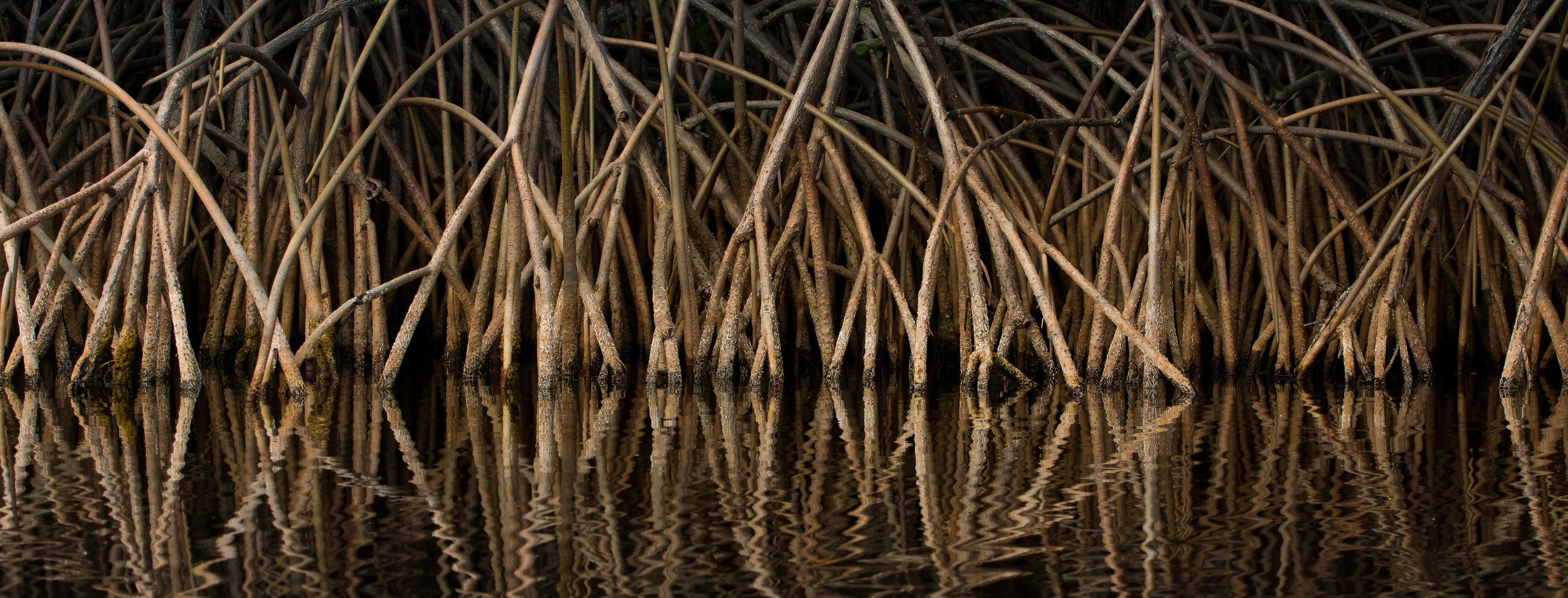
In addition to helping to address climate change, mangroves offer other significant benefits for the environment, local communities, and key global industries. An estimated 700 billion juvenile fish and marine invertebrates are born in or near, and sustained directly by mangrove ecosystems, including many commercially and nutritionally valuable species (4) — that is roughly equivalent to ⅓ of all global wild-caught fish consumption every year (5). Globally, it is estimated that mangroves generate flood protection benefits valued above US$82 billion, shielding an estimated 18 million people from flooding each year (6). Mangroves also provide many other benefits such as timber and fuelwood for local economies, coastal pollution control, and tourism.
By sending a demand signal for high-integrity mangrove projects, Symbiosis aims to catalyze a high impact nature-based carbon removal pathway that is maturing rapidly but where a few scientific and methodological questions are still being refined (e.g., estimation of advected inorganic carbon dynamics). By engaging in mangrove projects now, we aim to help advance the broader market, support new buyers with direct stakes in coastal resilience — such as shipping and hospitality — and shine a light on best-in-class mangrove projects.
Other Blue Carbon Pathway We Considered: Peatlands
Peatlands — particularly those in Southeast Asia — represent some of the most carbon-dense ecosystems on Earth. When intact and waterlogged, they accumulate dense organic matter over millennia, locking away vast quantities of carbon. But when drained for agriculture or development, they become major sources of greenhouse gas emissions. Rewetting degraded peatlands can halt these emissions and, over time, restore their function as carbon sinks. Beyond climate, peatlands regulate hydrology, reduce flood risk, and support unique biodiversity.
We focused our review on tropical peatlands because they offer greater potential to generate carbon removals on shorter timescales than peatland projects in temperate regions. When deciding whether to prioritize a project pathway, we consider factors such as potential climate impact at scale, scientific and technical readiness, the presence of active project developers, supportive policy conditions, member interest, and whether Symbiosis demand could meaningfully accelerate progress.
After extensive consultation and review of tropical peatlands, we concluded that the pathway is not yet mature enough for inclusion in the next RFP.
Here’s where action is needed for Symbiosis to pursue tropical peatlands:
Methodology innovation: With only one active methodology currently available for tropical peatlands — BCR0007 v1.1 — expanding and strengthening existing methodologies is a priority. Including currently excluded ecosystems (e.g. coastal marine humid areas), reactivating Verra’s VM0027, or developing new methodologies, would give developers the tools needed to design credible, scalable projects across diverse tropical peatland landscapes.
Data generation: Foundational datasets — including peat extent and depth, emissions factors, aboveground biomass, soil carbon stocks, and methane flux — remain limited or unevenly distributed, especially outside Southeast Asia. Targeted research investments are needed to fill these gaps and support accurate baselines, monitoring, and verification.
Technical guidance: Paludiculture offers a pathway to align restoration with sustainable livelihoods, yet technical standards, definitions, and best-practice frameworks for tropical contexts are still underdeveloped. Clear guidance is necessary to help project developers and communities confidently integrate these approaches into project design.
For now, our focus remains on reforestation and agroforestry and on mangroves, where the market infrastructure, methodologies, and data are further along. Symbiosis will continue engaging with researchers, methodology developers, and standards bodies working to close these gaps. When the pathway matures, we'll be ready to act.
What’s Next
These updates represent the next step in Symbiosis's mission to catalyze high-integrity nature-based carbon removal. We plan to launch our mangroves RFP in the first half of 2026, continue to evaluate reforestation and agroforestry projects that have progressed since the first RFP, and open the process to new R&A projects as well. We will announce new reforestation and agroforestry offtakes and will continue evaluating new pathways to expand our impact.
Join us for a webinar on March 26 at 11 am ET (Register Here!) to learn more about the updated Quality Criteria.
Read the Quality Criteria Here
A special thanks to TerraCarbon for their analysis and support in this work! We are also grateful to our Technical Advisory Board and the following independent technical experts who reviewed and provided input to the mangrove criteria:
Mark Beeston, Conservation International
Pamela Castell de Oro, UC Berkeley
Leah Glass, Silvestrum
Whitney Johnston, PhD, Salesforce
Gabriella Kitch, PhD, Yale University
Deborah Lawrence, PhD, Calyx Global
Ryan Moyer, PhD, Terracarbon
Noah Planavsky, PhD, Yale University
Philip Platts, PhD, BeZero
Stefanie Simpson, The Nature Conservancy
Stuart Stokeld, Sylvera
Katey Valentine, PhD, BeZero
References:
Mcleod, E., Chmura, G. L., Bouillon, S., Salm, R., Björk, M., Duarte, C. M., ... & Silliman, B. R. (2011). A blueprint for blue carbon: toward an improved understanding of the role of vegetated coastal habitats in sequestering CO2. Frontiers in Ecology and the Environment, 9(10), 552-560.
Wang, M., Zhang, T., Xie, Y., Zhang, Z., & Wu, X. (2025). Mapping accumulated carbon storage of global mangroves from 2000 to 2020 at a 1 km resolution. Scientific Data, 12(1), 552.
Mcleod, E., et al (2011)
Zu Ermgassen, P. S., Worthington, T. A., Gair, J. R., Garnett, E. E., Mukherjee, N., Longley-Wood, K., ... & Spalding, M. D. (2025). Mangroves support an estimated annual abundance of over 700 billion juvenile fish and invertebrates. Communications Earth & Environment, 6(1), 299.
Mood, A., & Brooke, P. (2024). Estimating global numbers of fishes caught from the wild annually from 2000 to 2019. Animal Welfare, 33, e6.
Beck, M. W. et al. The Global Value of Mangroves for Risk Reduction: Summary Report. 2018.